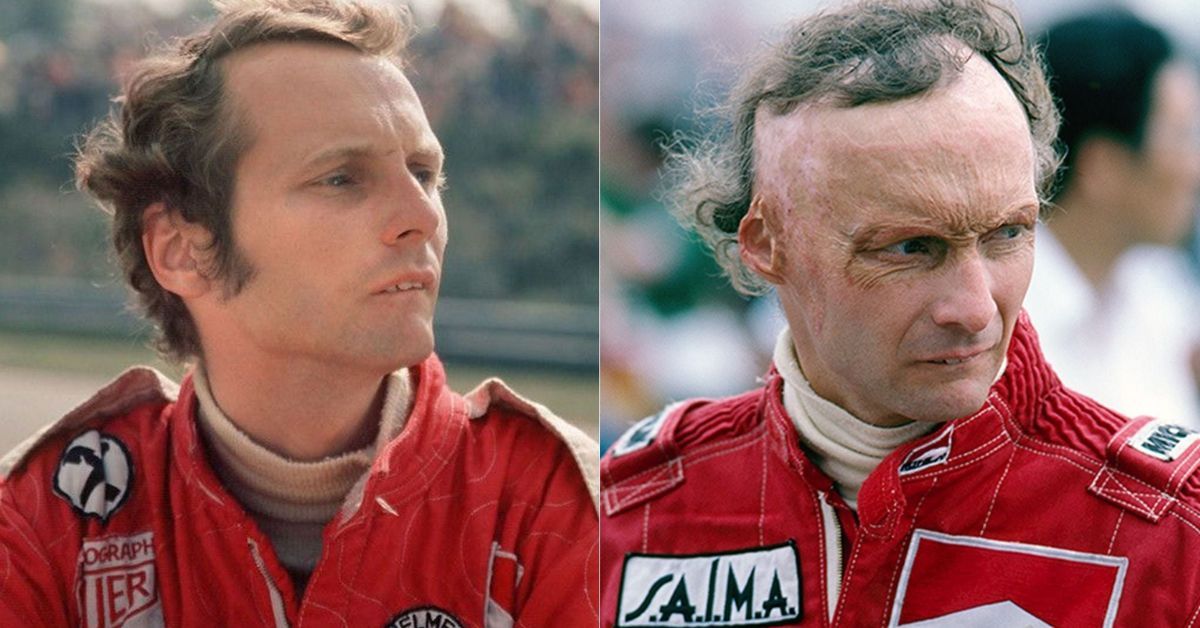
The 1976 German Grand Prix at the Nürburgring’s Nordschleife circuit became one of Formula 1’s most defining events in history, not for the racing, but for the tragedy and comeback that would follow. On August 1, reigning world champion Niki Lauda lost control of his Ferrari 312T. The car was sent into the unforgiving walls of the circuit, instantly setting it on fire.
Trapped in the inferno for nearly a minute before being pulled out by fellow drivers, Lauda suffered catastrophic injuries that should have ended his career. While doctors predicted months of recovery, if he survived at all, Lauda was back in a Formula 1 car just 42 days later at the Italian Grand Prix.
Niki Lauda Defying Death and Doctors
Rescued by fellow drivers Arturo Merzario, Guy Edwards, and Brett Lunger, the extent of Lauda’s injuries were almost incomprehensible: third-degree burns to his face and scalp, severe lung damage from toxic fumes, and the loss of his right ear and eyelid.
The injuries were so severe that priests administered last rites at the hospital when he arrived. He endured excruciating treatments. Doctors scraped dead tissue from his burns without anaesthesia and performed emergency eyelid reconstruction to save his vision.

3× World Champion
Yet within days of regaining consciousness, the reigning world champion began plotting his return. He demanded updates on the championship standings and his rival James Hunt’s performance. While still breathing through open wounds in his lungs, Lauda started training in his hospital room, performing breathing exercises to rebuild his lung capacity and physical therapy to regain movement in his badly burned hands.
Against medical advice, he discharged himself after just 11 days to begin training. His wife, Marlene, later recalled finding him doing weighted squats while his skin grafts were still fresh, blood seeping through his bandages. Yet, Lauda’s mental fortitude proved stronger than his physical injuries.
The Miracle of Monza
Just 42 days after the crash, a gaunt, bandaged Niki Lauda shocked the racing world by returning to racing. His return at Monza on September 12, 1976, became a universal symbol of resilience. Through sheer willpower, he not only completed the race but scored championship points.
His burns were so severe that he could barely fit his helmet over the dressings. During the race, the vibrations caused unbearable pain as his raw wounds rubbed against his balaclava.
In spite of this, Lauda qualified in seventh place and managed to finish fourth place in the race. As the Austrian racing driver later said, “The accident changed nothing in my head. I knew I would race again”.
Italian Grand Prix 1976
Autodromo Nazionale di Monza · Monza, Italy — 12 Sept 1976
| Pos | Driver | Team | Time / Status | Pts |
|---|---|---|---|---|
| 1 | Ronnie Peterson | March | Finished | 9 |
| 2 | Clay Regazzoni | Ferrari | Finished | 6 |
| 3 | Jacques Laffite | Ligier | Finished | 4 |
| 4 | Niki Lauda | Ferrari | Finished | 3 |
| 5 | Jody Scheckter | Tyrrell | Finished | 2 |
Lauda was still able to finish 2nd in the Drivers’ Championship, missing out on the title by only 1 point to James Hunt. In addition to this, his efforts helped cement Ferrari as the 1976 Constructor Champions.
His 42-day recovery became a universal symbol of resilience. He would go on to win two more world championships in 1977 and 1984, proving that his talent remained undimmed by the accident.
This extraordinary chapter of motorsport history was immortalised in ↗︎the 2013 film Rush, vividly depicting Lauda’s crash, agonising recovery, and fierce championship battle. Daniel Brühl’s portrayal captured Lauda’s determination as he fought back to racing, showcasing the human drama behind one of the greatest comebacks.
The fiery crash at Nürburgring could have been the end of Niki Lauda’s story. Instead, it became the defining chapter of a legend that showed us that the human spirit can achieve the impossible.
This superhuman comeback wasn’t just about returning to racing. It was about refusing to let circumstance dictate his limits, a lesson that continues to resonate so far beyond the world of Formula 1.